 Home
Memories of Wollaton Past
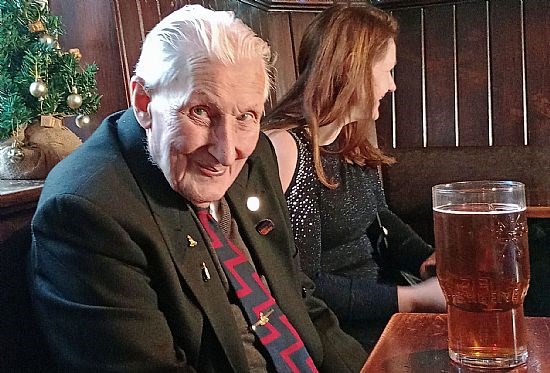
Ron Cruxon
The Village
Did you know? The pump in the square was erected to commemorate the 21st birthday of a son of Lord Middleton. However, the pump never drew water. The people who lived around the square got their water from a pump in the field where the Community Centre now stands. The pump did serve one useful purpose, though. Carters tied their horses and carts to it while they went for a drink.
The Stone Cottage opposite the church was once a hospital called St Aidans. It was for people taken ill while on pilgrimage to Lenton Priory.
The cottage next to the church gateway was where the village policeman lived. There was a plaque over the door saying "County Police". The first policeman was P.C. Joe Wilson. When he retired, P.C. Joe Cutall took over and remained there until Wollaton became part of the City.
The village had a noticeboard fixed to the side wall of the first cottage in the Square, which announced all the goings-on. There was also a church magazine run jointly with Cossall. The Wollaton News was printed on the front and the Cossall News on the back cover. The inside pages arrived pre-printed.
At the bottom of Church Hill, near the entrance to Hirst Crescent, was a mortuary. It was a wooden structure, and sometimes you could see through a gap in the woodwork and spot a body that had been pulled out of the canal.
In the back yard at the Old Rectory were two parish rooms where the Parish Council met. The Mothers' Union also met there, as did the Scouts and Guides later on. There were whist drives, tea parties and jumble sales. Even the village football team changed there once they had moved to playing on Parson's Field. Previously, they had played on a field lower down the Main Road.
The first schooling in the village was held in the clubroom at the Rodney. Pupils were asked to pay one penny per week to cover the cost of slates and pencils. As the village school was a Church of England school, the children would walk in file to the church once a year for a service. Every Friday morning, the Rector would visit the school to give the scripture lesson.
There were two playgrounds at the school, one for girls and one for boys. In the boys' playground was a huge conker tree in the middle, which did not help when you were trying to play football. In 1928, when the Royal Show was held in the fields where Russell Drive is now, the schoolchildren were allowed to assemble inside the entrance to wave little Union Jacks to welcome King George and Queen Mary, who attended on the Wednesday.
The school had a Maypole, which was put up in the schoolyard for practice before the main performance at the Annual Fete and Garden Party held on the Rector's lawn. At the fete there would be skittling for a pig and competitions involving knocking six-inch nails into a block of wood, using the hardest wood they could find at the sawmills. The Mothers' Union would be there with their tea and cakes. There were also competitions to guess the weight of a cake or the name of a doll, along with stalls of all kinds. Later on, the Scouts and Guides would contribute with various activities.
The annual Shrove Tuesday concert was held in the schoolroom. Anyone who could sing, tell a monologue, dance, do the hornpipe or perform in some other way took part. I made several appearances, but my best part was being carried onto the stage in a sack by Father Christmas (Mr Saul). I would have been about seven at the time. I appeared out of the sack to make a speech and present a Westminster Clock to Miss Booth to mark her retirement as infants' teacher. The proceeds from the concert paid for the church choirboys' outing, usually a day at Skegness.
Oakey, Oakey Nettle Day took place every Ash Wednesday. The boys would arm themselves with the biggest stinging nettle they could find, and anyone not wearing a sprig of oak would be subject to an attack.
The canal that ran through the village was owned by the railway company. The towpaths were freely accessible to everyone, and very pleasant they were too! However, to prove it was private property, the gates giving access were padlocked for one day each year.
The village had a thriving fishing club for men and boys, with annual matches held on the canal. There were also outings for the men to fish the Trent and other waters. Once a year, a Sausage and Mash supper was held in the Rodney clubroom, when the prizes were given out.
The Secretary of the fishing club was Mr James Newbury, who lived in the Pig Yard. Day tickets were available for nine members at 3d a day. Jugs of tea were sold from a cottage on the canal side.
The village cobbler lived with his two brothers and a sister at the family home, a cottage close to the railway bridge. Jack Lepton carried on his business from a shed in the garden. As boys, we would sometimes sit with Jack watching him work. Although he had only one leg, Jack could be seen keeping up with his mates on a night out to the Gallows Inn at Ilkeston or the White Horse at Radford.
The first daily newspaper delivery service in the village was run by Gladys Upton from a shed in the garden. Gladys was the sister of the village cobbler. Before Gladys started her business, the nearest newsagent was next door to the White Horse at Radford. On pit-working days, one of the miners would bring us a paper. Otherwise, we had to walk to Radford for one.
The village milk-maid, Ascough's, lived at the farm now called Bridge House, close to the canal bridge. When the estate was sold, Mr Ascough was able to buy a couple of fields on the other side of the railway. As his daughter married a builder, they were able to build two new houses next to the railway bridge and continue to run a milk herd.
Young Mrs Ascough, the daughter-in-law, could be seen each morning trudging around the village with two pails of milk, ladling it out into jugs for the villagers. There was also a second dairy herd in the village, at the Old Farm House at the top of Russell Drive, run by Mr and Mrs Walker. Milk from this herd was collected in bulk by Weldon's Dairies. On many occasions, my father would be called upon to milk either of these herds before going to work.
There was a thriving Lodge of the Ancient Order of Oddfellows in the village. They first met in the Rodney clubroom and later at the Institute. The Secretary was Mr Whiting, who was the Chief Clerk at the colliery. The Lodge had a beautiful, large banner in blue and gold, with two poles and four rope stays, which was paraded on occasions. On Founders' Day, we would parade with the banner from Market Square to High Pavement Chapel for a service. The last two carriers of the banner were George Falconbridge and myself.
The Wright Memorial Institute was erected for the benefit of the estate workers, as was the custom on large country estates. The workers could gather in the evenings and enjoy a game of billiards, dominoes or cards. The Institute was named in memory of Mr William Wright, who was the agent for the estate. Mr Wright lived in a large house halfway up Church Hill and could often be seen checking on the village by riding around on a white horse.
Memories of My Father
My father was born at Burrington, Herefordshire. While still a small child, his family moved to Sutton Maddock, Shropshire. His father was a gamekeeper. My father had three brothers and three sisters. I never knew my grandparents, as there was no money to spare for train fares.
My father was a good talker, and we would spend many dark nights sitting by lamplight, listening to tales of the countryside. I do not remember much talk about school, but I used to think what a knowledgeable man my father was. We would go for a walk on a clear night, and he could name all the stars, things his father had taught him. He knew every bird and other forms of wildlife. He would say, "Stop and listen, that's a nightjar", or "There's a nest in that bush, what colours are the eggs?" and "Yes, that's so and so."
One day, we were walking in the park, Dad and Mum and three lads, when something fell from a chestnut tree as we reached the top of the drive. Dad picked it up and put it in his coat pocket. When we arrived home, we found it was a baby jackdaw.
We put it in a basket on a piece of flannel by the fireside, as we did with chickens when they hatched. When it was able to fly, Dad built it a wire-mesh cage, which stood on top of a shed. The bird lived on for years. Jack, as we called him, never came into the house except through the bedroom windows. He would pick things up, such as clothes pegs from the line or pearl buttons from my sailor suit, and neatly hide them under the folds of the sheets on the bed. Dad would open the cage in the morning, and Jack would fly around happily all day long.
Dad had a black-and-white sheepdog named Joe, after Joe Stalin, who was in favour at the time. Joe always knew when it was nearly a quarter past three in the afternoon. He would stand at the back door with his ears pricked, listening for the buzzer that sounded when the pit finished work.
As soon as the buzzer sounded, Mother would open the door, and Joe would tear down Colliery Row to meet his master coming home from work. On seeing Dad, Joe would jump up, and Dad would knock his cap off, which Joe would catch. Dad would then say, "Now go and tell Mother I'm on my way and put my dinner out." The dog would chase back home, still carrying his cap.
As time went on, Jack the jackdaw picked up the habit of following the dog, and Jack also began meeting his master coming home from work. He would fly on and off Dad's shoulder as Dad walked up Colliery Row, where there was a low brick wall in front of the houses. The bird would fly from Dad's shoulder to the wall and back, until one day a dog hiding behind the wall waited for the bird, jumped up and grabbed it. That was the end of poor Jack.
To get back to the beginning, when the children left school, Uncle Tom followed his dad and also became a gamekeeper. My father went into service. Uncle Fred became a farrier, and Uncle Percy had a pig farm.
Dad worked in service at a number of places, including Bradgate Park, before joining the staff at Chatsworth House. Dad was a boots at Chatsworth and, of course, lived in at a time when royalty were regular visitors. He tells of many times going out on shoots, sometimes acting as loader for the King.
They also had many happy times at the Institute at Edensor. The Duke encouraged his men to join the Territorial Army. Dad was part of the Army Service Corps (later the RASC) at Chesterfield, attached to the Derbyshire Yeomanry. The annual camp of 1913 was held at Clifton Pastures. At the end of the fortnight, the unit moved away to prepare for war. The unit was later moved to Palestine, still with the Derbyshire Yeomanry.
In 1916, it appeared in Army Orders that, because the army was so short of men in France, anyone volunteering would be given ten days' leave before being sent to France. Dad was already on friendly terms with my mother, who also lived in at Chatsworth as a laundry maid. Mother gave up her job and waited at home for Dad to begin his ten days' leave.
On the second day at Wollaton, Dad and Mum walked down to church at eight o'clock in the morning, and the Rev. Russell married them. When the war ended in 1918, Dad did not return to Chatsworth but decided to take his chances at Wollaton.
Next door to my grandparents on Trowell Road, opposite Waitrose, was A. A. Hayard, who also had a field and stabling and paid men to run his horse-and-cart business. Dad applied for a job and started work at 1d per hour.
It was not long before Dad discovered that the other men were getting 1½d per hour, so he went on strike. His next job was with a road-repair unit belonging to Basford Rural District Council. The unit consisted of a tar spreader, loads of grit and a steam roller. That job did not last long.
He then went to work for Smith's Flour Mill at Trowell, driving a team of four horses and a flat dray, delivering sacks of flour to wholesale grocers such as Farrards and Marsdens.
In 1920, a cottage became vacant near the canal bridge. Dad learned from the Estate Office that the cottage was let to Mrs Hodgkinson at the Rodney. So off to the Rodney went Dad.
"Can I have your cottage, Mrs Hodgkinson?"
"Of course you can, but you have to work for me."
So Dad and Mum moved into the cottage, and Dad went to work at the Rodney. His main job was brewing the beer and working behind the bar. The cottage was semi-detached and stood ninety yards back from the road. The frontage was all garden, which kept us going with vegetables.
There were two dairy herds in the village at this time: Ascoughs at Bridge Farm, later moved to the railway bridge, and Walkers at the dairy further down the road towards the village. Dad was often called out to milk the cows at either herd before working at his other jobs.
1925
The year was now 1925, when everything changed for the village with the sale of Lord Middleton's estate. In the meantime, the boys had been born in the cottage: Harold in 1920, myself (Ron) in 1922 and Arthur in 1924. The family continued to live in the cottage, which was bought at the sale by Mr C. Allcock, at a rent of 3s 4d per week.
The estate of the Right Honourable Lord Middleton, comprising 4,164 acres, was sold on 23 and 24 March 1925 at the Mechanics Lecture Hall, Nottingham. Included in the sale were 19 farms, 29 smallholdings, 800 acres of building land, 14 residences, 141 cottages, 313 acres of woodland, a sawmill, a pub, a brick yard and a clay pit.
Not sold were Wollaton Cricket Ground, Wollaton School, Wollaton Village Institute, Trowell School and School House, and Cossall School.
The cricket ground was excluded from the sale of the estate, having been left to the village by Lord Middleton. The Cricket Club still plays there. Some years later, an adjoining part of a field was added to the cricket ground so that the football club could play there too. The football team had previously used a field attached to the Old Rectory, let to the Rev. J. G. Thornton. One of the parish rooms was used as a dressing room.
The Wollaton Tennis Club and, later, the Wollaton Bowls Club also used the cricket ground. The Cricket Club was always well supported, and as a small boy I and others were kept busy putting up the scores on the scoreboard as they were called out by the scorer, Percy Ping.
About this time, the Raleigh Cycle Company bought a number of fields on Coach Road to site the Raleigh Athletic Club playing fields. The senior football team played in the Notts Alliance League and was captained by Ted Saxton, who played at full-back. The team contained a number of ex-professionals. You could always get a job at Raleigh if you were a good footballer, as at other big firms. As it was free, a number of other village boys became Raleigh supporters.
The Admiral Rodney was sold to the Home Brewery Company at Daybrook, so Dad lost his job.
The Home Farm was closed down, so the manager and his wife, Mr and Mrs Carrington, moved to Bulcote to run another farm. Their son George had just become established as under-gardener at Colonel Forman's, who had bought the Estate Manager's house. George stayed in Wollaton and lodged at my grandmother's.
The Wollaton Walled Garden, or "kitchen garden", was sold to a nursery firm named Hogsons.
Dad got a job at the pit top and stayed there until he retired. The pit only worked three days a week in those days, so every Tuesday and Thursday Dad had to sign on at the dole office on Castle Boulevard, at the corner of Wilford Street. They were excused on Saturdays.
Dad would walk to Nottingham and, if there was no school, one of the boys would go with him. If we were lucky, we would get a lift on Jim Smith's coal cart as far as Lenton Boulevard, where a penny (½d for the lad) would take us to Walter Fountain, at the corner of Greyfriars.
Dad's wages from the pit were 19s 11d, plus three days' dole, so he was always looking for odd jobs to earn a few coppers. He became a window cleaner, cleaning windows at the houses on Colliery Row for 3d each. He also cut the grass in the churchyard and the cemetery. Dad and I would spend all afternoon sawing wood for the Head Forester and would be given a plate of bread and jam and a mug of tea.
I was paid a shilling a week by the Fishing Club to pick up all the litter along the towpath from Pit Lock to Raymore Bridge. I also earned half a crown a month to deliver a copy of the Wheatsheaf to every house in Wollaton, on behalf of the Stapleford and Sandiacre Co-op.
All the money was handed over, and we were glad to do so, for we lived well. We always kept chickens, and any spare eggs in the summer months were preserved in water glass for the winter to make sure we always had fruit cake. Uncle Tom would send a brace of pheasants and partridges at Christmas.
1933*
Before the village of Wollaton was taken into the boundaries of the city of Nottingham, there was no electricity, gas or water laid on through the village. Heating was by coal fires. Cooking was done in a pan over an open fire or in a side oven, part of the kitchen range. Lighting was by paraffin lamps or candles. Drinking water was drawn from the well, and hot water was obtained from a boiler at the side of the kitchen fire.
In 1933, however, the village was incorporated into the city of Nottingham. One of the first things that happened was that the roads were dug up to lay water pipes, gas pipes and electricity cables. About a year later, work began to connect all the cottages to the water and electricity supplies. Any house that was not connected was condemned by the Council and pulled down.
Two semi-detached cottages on the Main Road, where the landlord said he could not afford to have them connected, were pulled down. My grandmother and her neighbour, Mrs Clark, were moved to houses on Beechdale Road when they were first built to provide homes for people displaced by slum clearances.
The Lighting of Wollaton
The first street lamps were erected shortly after the cables and pipes had been laid through the village. The lamps were of a hanging type, gas-fired through a single mantle and ignited by clockwork. There were 19 lamps in all, erected between the Woodyard at one end and the Tottle Brook on what is now Trowell Road.
The first lamplighter was my father, Mr Will Cruxon, who worked part-time and was paid ten shillings per week. His duties included an evening inspection to make sure the lamps came on and a morning inspection to make sure they had gone out.
Once a week, all the lamps had to be cleaned, using a ladder carried around by the lamplighter. During the summer months, the lamps were taken down and stored in the attic of our cottage.
In the years that followed, as the lighting was extended, its operation was taken over by the Lighting Department. The full-time lamplighter for Wollaton then became Bill Hollingsworth, who lived on Berrisford Street, Radford.
Buses
The first bus seen in the village, I am told, was driven by Charlie Banner, who lived at the farmhouse now known as the Old Post House. Before this, there were the occasional open-top charabancs with solid tyres, usually used for a church outing or to take the long-alley skittle team from the Rodney to play an away match.
The first service buses from Nottingham to Ilkeston were two small green buses owned by Nobby Clarke.
Next came Bramley's, with large single-deckers. Then came the Prince of Wales buses, followed by Trent for a short time. Trent gave way to Midland General, which ran the service throughout the war years and afterwards. Now we are back with Trent Barton.
After Mr Clarke was run off the road by Bramley's, he ran a mobile fish-and-chip business through the villages until it caught fire one Saturday night just over the canal bridge. Later, Mr Clarke became a newsagent, with a shop at the top of Russell Drive.
When the buses started running, the fare from Wollaton to Nottingham was one shilling and sixpence for a monthly return. The return ticket later increased to two shillings and threepence. In time, the bus company realised that monthly return tickets were being passed from neighbour to neighbour, so that put a stop to monthly returns!
For most of the time I remember using the buses before the war, the fare from Wollaton to Nottingham was 3d single and 5d return.
*The year of incorporation has been amended from 1932 to 1933 to reflect the historical record.
Authored by Ron Cruxon, February 2020
You can read more about Ron's life story in the booklet The Life and Times of a Wollaton Man, which is available to buy on our Publications page.
Notts TV caught up with Ron Cruxon in 2021, following the publication of his book. View the footage in their Facebook Reel.
Ron Cruxon 1922-2023
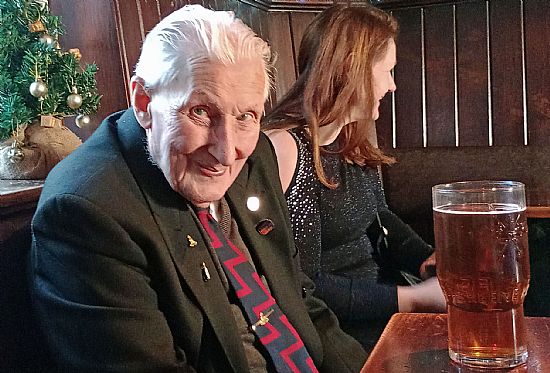 We are sorry to have to have to report that our centenarian Ron Cruxon died peacefully at 3.00am on 31 August 2023 in hospital. He had been in hospital for a few days and during that time he was visited by, or spoke to members of his family, some of whom were with him at the end.
Ron had been a member of WHaCS since its inception over 50 years ago. He regularly attended our public meetings until the onset of Covid. He was an invaluable source of local information having lived his whole life (apart from World War II) in Wollaton Village and had, to the end an amazing memory of people and events. I encouraged him to write his memories down and during Lockdown he did and I was delighted to put these together in The Life and Times of a Wollaton Man which was published by the Society and has recently been republished. It will remain his lasting legacy, being now the first in our new Your Wollaton book series. I need hardly say that without his support and the £4,000 from the sales of his book, we would never have been able to raise the necessary funds to restore the Cucumber House so quickly.
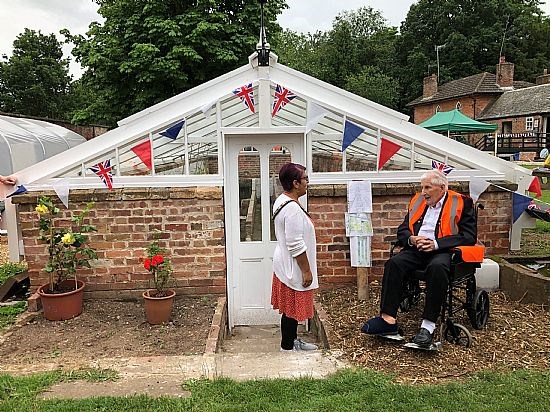 Ron Cruxon at the restored Cucumber House
Ron took great pleasure in meeting people and was delighted when people asked him to autograph his book. He loved visiting the Wollaton Walled Garden and seeing the massive amount of work done by the volunteers and marvelled at the reconstruction of the Cucumber House. He was delighted to be present in June when he and the Sheriff performed the formal opening.
Ron was called up in 1940 and served in the Royal Artillery, landing in Normandy some days after D-Day and was subsequently involved in the liberation of France and Belgium and was with one of the first regiments to cross the Rhine into Hitler's Germany in March 1944 (a topic I discussed with him only a week ago, his memory still being excellent). In 2018, in recognition of his service in the liberation of France, he was made a member of the Legion d'Honneur presented to him by the French Consul at an event at Wollaton Hall.
Ron's wife died many years ago and he subsequently lived alone but was supported by his extended family and friends. He will be greatly missed.
Written by Andrew Hamilton